Why You Keep “Starting Over” (And What to Do Instead)
Apr 25, 2026
Why You Keep "Starting Over" (And What to Do Instead)
One of the most common things I hear as a dietitian and nutrition coach is some version of this: "I was doing so well, and then I just fell off. Now I feel like I have to start over."
Or this: "I'm doing everything right, but I'm not seeing anything change."
If that sounds familiar, I want you to know that it has very little to do with lack of willpower, lack of motivation, or lack of knowledge. In my experience working with clients, the people who feel stuck in this cycle almost always share the same root issue. It's not that they don't know what to do. It's that the way they're approaching habits and consistency is working against them.
Let's talk about why and more importantly, what to actually do instead.
The Phase Where Most People Quit
If you've read Atomic Habits by James Clear, you may be familiar with what he calls the "valley of disappointment." If you haven't read it, I'd put it on your list because it's one of my favorite books on behavior change.
The valley of disappointment is that phase where you're showing up. You're trying. You're being consistent, checking the boxes, doing the things you know you're supposed to do, and you're not seeing much of anything change yet. Your clothes feel the same. The scale hasn't moved. Your energy is maybe slightly better, but nothing dramatic.
This is where most people quit.
And it makes complete sense that they do, because it genuinely feels like it isn't working. Why would you keep going if you're putting in the effort and seeing nothing?
Here's the thing though — you're not failing. Your results are just delayed. Progress in nutrition and health is almost never linear. I tell clients this all the time: it's more like a zigzag line than a straight one. Great weeks, then frustrating weeks, then a stretch where things start clicking. The people who actually see results are the ones who stay consistent through the valley, who keep doing the basics even when it feels like nothing is happening. Because usually, that's right before things start to shift.
You Don't Need More Motivation. You Need Better Habits.
When progress feels slow or stalled, it's tempting to think the solution is more: a better meal plan, more discipline, more motivation to get it together. But in my experience, that's almost never what's actually missing.
What's missing is small, repeatable habits that fit into your actual life.
Not a complete overhaul. Not starting over every Monday with a new plan. Not doing everything perfectly for four days and then falling off when the weekend hits. Just consistently doing the basics, most of the time.
The problem with most intentions people set around health is that they're not specific enough to turn into a real habit. "I'm going to meal plan more" is not a habit. "I'm going to work out more" is not a habit. "I'm going to drink more water" — also not a habit.
A habit needs a time and a place attached to it.
"On Saturday mornings at 10am, I sit down with my coffee and plan out my meals for the week" — that's a habit. It's specific, it's anchored to something you already do, and your brain knows what to do with it.
This matters because most of us are relying on willpower to drive our health behaviors, and willpower is one of the most unreliable resources we have. It's high when you're fresh and motivated, and it fades fast when you're tired, stressed, or just having a normal human week. Habits that rely on willpower to execute are habits that only work when everything is going well.
The better approach is to design your environment so that the habit you want to build is the path of least resistance. That might look like:
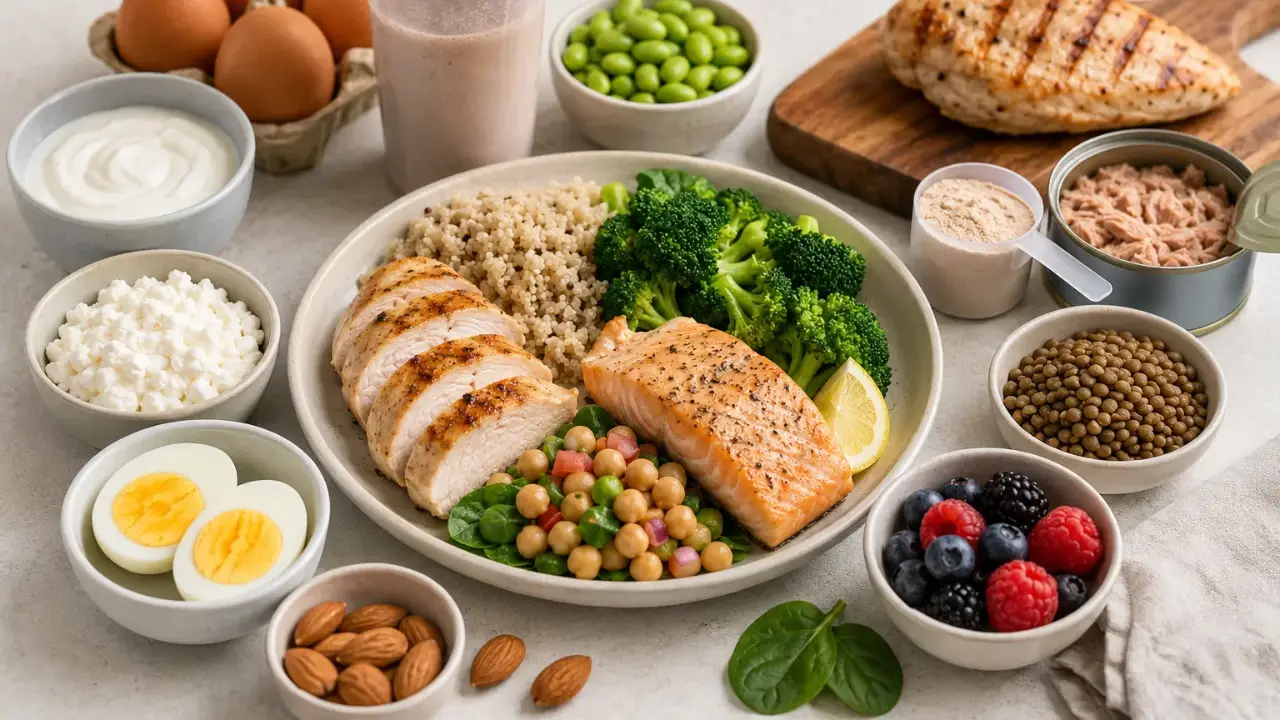
- Keeping easy, grab-and-go protein options prepped and visible in your fridge, so hitting your protein goals doesn't require a production every morning
- Putting your water bottle on your desk or kitchen counter the night before
- Deleting social media from your phone to protect the time and mental energy you actually want for other things
- Not keeping certain foods in the house if you know from experience they're hard to moderate — not because you're restricting yourself, but because you're removing a friction point
None of this is about deprivation. It's about setting yourself up so the choice you want to make is also the easy choice.
The All-or-Nothing Trap
This one I take personally, because I lived here for years.
The all-or-nothing trap goes something like this: you eat a meal that feels "off plan." Maybe it was unplanned, maybe it was a social event, maybe you just wanted pizza. And then instead of moving on, something shifts — well, I already messed up, I might as well just start over Monday. And then Monday comes, and you start strong, and then a few days later the same thing happens again.
That cycle will keep you spinning your wheels indefinitely, and it's not because you have a discipline problem. It's because perfectionism isn't actually a sustainable strategy , and no one will ever be perfect in their pursuit of health.
Here's a reframe I use with clients constantly: the 90/10 approach. About 90% of your choices reflect your goals, and about 10% is flexible — for the birthday dinners, the vacation meals, ice cream with your kids, the moments that are part of living a normal life. You don't need to be perfect to see results. But you do need to be consistent.
One off meal doesn't erase your progress. One skipped workout doesn't undo your hard work. What matters is what you do most of the time, over time — not what you did on any single day.
The quicker you can make peace with imperfect consistency over perfect streaks, the quicker you'll actually start to see the results you've been working toward.
What To Do If You're In the Valley Right Now
If you're reading this and you feel like you're in the valley — like you're doing the right things but not seeing results, or like you've been starting over so many times you've lost count — here's what I want you to do.
Simplify.
You don't need a more extreme plan. You don't need to be more perfect. You don't need to overhaul your entire life by next Monday.
You need to pick one or two habits, make them specific with a time and place attached, and do them consistently for the next few weeks. Let them become automatic before you layer anything else on top. Small and consistent will always outperform big and unsustainable.
And if things feel slow right now, or like it's not working yet, remind yourself of the valley of disappointment. The delayed results phase is real. Staying consistent when nothing seems to be happening is genuinely hard, and it's also usually exactly what's required right before things start to change.
You don't have to start over. You just have to keep going.
Rachel is a Registered Dietitian and the founder of Everwell Nutrition, an insurance-covered virtual nutrition practice serving clients in Oklahoma. If you're ready to stop starting over and build a plan that actually fits your life, fill out an interest form — Rachel personally reaches out to every new inquiry within a business day.
Ready to get started with one of our dietitians? Most of our clients pay $0 using their insurance benefits!